
Myopia Management on the Upper West Side & in Scarsdale
Myopia control for children at our office on West 79th Street, just off Broadway on the Upper West Side, and on Weaver Street in Scarsdale: ortho-k, atropine drops, myopia control contact lenses and Stellest lenses.
Myopia management is care that aims to slow how quickly a nearsighted child’s prescription increases while the eyes are still growing. At Eye Q it is led by Dr. Abraham Zlatin, New York State’s first fellowship-trained orthokeratologist, and Dr. Zachary Zlatin, whose graduate research at SUNY Optometry was in myopia control. Both see children at our Upper West Side and Scarsdale offices.
Ordinary glasses and contact lenses sharpen the blur, but they do nothing about the growth behind it. The treatments on this page are designed to do both. All of them are available at both offices, and we choose among them with you once we have measured your child’s eyes.

Advanced Ortho-K (AOK Molds)
AOK molds are custom rigid lenses your child wears only while asleep. Overnight they flatten the center of the cornea very slightly, so the lenses come out in the morning and distance vision stays clear through school, sports and screens without glasses. The same reshaping changes how light reaches the outer retina, which is thought to be why ortho-k slows the eye’s growth in many children.
Each mold is designed from a map of that eye’s cornea rather than picked from a stock size. Dr. Abraham Zlatin has designed ortho-k lenses for more than 20 years; in 2002 he was one of the first doctors certified in Corneal Refractive Therapy.
What Is Myopia?
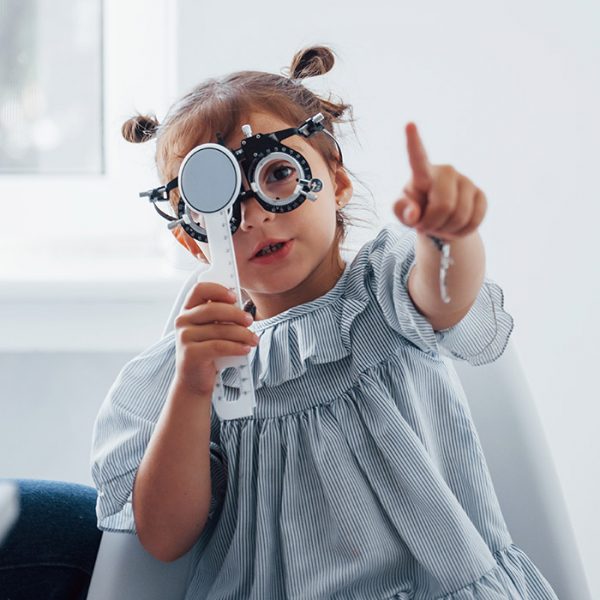
Myopia, or nearsightedness, means distant things look blurry while close ones stay sharp. In most children it happens because the eyeball grows slightly too long from front to back, so light from far away comes into focus before it reaches the retina. It usually appears during the school years and tends to increase until growth slows in early adulthood.
How high it climbs matters later in life. High myopia is linked with a greater lifetime risk of retinal detachment, glaucoma, cataracts and myopic macular degeneration, so a lower final prescription is about long-term eye health as much as thinner lenses.

Why More Children Are Nearsighted
Myopia has become far more common in children over the past few decades, and it is starting at younger ages. Researchers point to a mix of family history and daily habits: long stretches of reading and screen use up close, and too little time outdoors in daylight.
A child with one or both parents nearsighted is more likely to become nearsighted, and myopia that begins young has more years in which to progress. Both are worth mentioning at your child’s eye exam.
Treatments We Use for Myopia Management
AOK Molds (Overnight Ortho-K)
Worn at night and taken out in the morning, AOK molds leave the day free of glasses and daytime contacts, which many families value for sports and swimming. They suit children who are ready, with a parent’s help, to keep a nightly cleaning routine. Fitting starts with a map of each cornea, and before the first night at home your child wears the new molds in our office for about two hours so we can check how the cornea responds.
Low-Dose Atropine Eye Drops
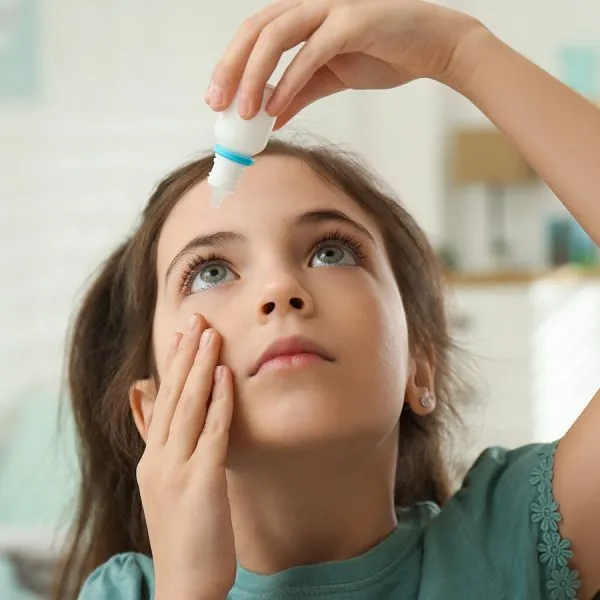
Low-dose atropine is a prescription eye drop used once a day to slow the lengthening of the eye. The strengths used for myopia are a small fraction of standard 1% atropine. Some children notice mild sensitivity to bright light or slightly softer focus up close. Drops can be used on their own or together with other treatments, depending on how quickly a prescription is changing.

Myopia Control Contact Lenses
These are soft daytime contact lenses with a special optical design: the center corrects distance vision, while the outer zones change how light reaches the edges of the retina, a signal linked with slower eye growth. They are a daytime alternative for children who aren’t ready for overnight lenses, or who already wear soft contacts comfortably.
Essilor® Stellest® Lenses
Stellest lenses look like ordinary glasses. Around a clear center for sharp distance vision, each lens carries rings of tiny lenslets that focus part of the light in front of the outer retina, the signal intended to slow elongation. In September 2025 the FDA authorized Stellest as the first eyeglass lenses to slow the progression of myopia in children who start wearing them between the ages of 6 and 12.
They suit families who would rather avoid contact lenses, and children too young for them. Like every option here, they only work while they are worn, so they are prescribed as everyday, all-day glasses.
Daily Habits That Help
Time outdoors in daylight is linked with a lower chance of becoming nearsighted in the first place. We suggest daily outdoor play, regular breaks from reading and screens to look into the distance, and keeping books and devices at a comfortable distance rather than close to the face. Habits don’t replace treatment once myopia is progressing, but they support it.
Book a Myopia Evaluation in Manhattan or Scarsdale
If your child squints at the board, sits close to the TV or has needed stronger glasses at each visit, book an eye exam and ask about myopia management. We’ll measure your child’s eyes, explain which options suit their age and prescription, and set a schedule of follow-up visits to track whether progression is slowing.