
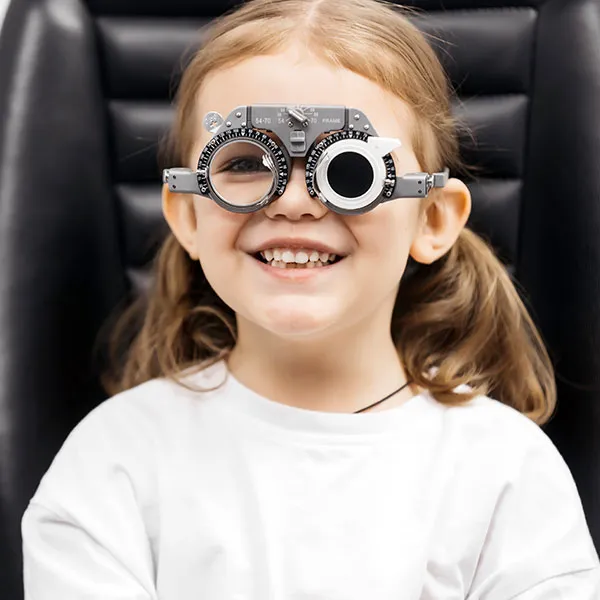
Children rarely complain about their eyesight. A child who has always seen the board as a blur assumes everyone does, and a child with one strong eye and one weak eye may not notice at all. That is why routine eye exams matter even when everything seems fine.
When to schedule an exam
Eye Q follows a simple timeline for children whose vision is developing normally:
- Around 6 months: a first check of eye health, alignment and focusing.
- Ages 2 to 3: a second visit as speech and coordination develop.
- Before first grade: an exam before reading and classroom work begin in earnest.
- Every year after that, through age 18: or as often as your child's optometrist recommends.
Book sooner if you notice a problem, if a school or pediatric screening flags a concern, or if there is a strong family history of eye conditions.
A screening is not an eye exam
Vision screenings at school or the pediatrician's office are useful, but they are designed to catch some problems quickly, not to evaluate the whole visual system. A child can pass a screening and still have focusing problems, mild farsightedness, eye-teaming difficulties or early nearsightedness. The American Association for Pediatric Ophthalmology and Strabismus describes screening as a first step that should lead to a full exam when it raises a concern.
A comprehensive exam measures your child's prescription, checks how the eyes work together and focus up close, and examines the health of the eyes themselves.
Signs worth mentioning to the doctor
Children with vision problems often adapt rather than complain. Watch for:
- Squinting, sitting close to the TV or holding books very near
- Covering or closing one eye
- Frequent eye rubbing or headaches after school
- Losing their place while reading, or avoiding reading altogether
- An eye that turns in, out, up or down, even occasionally
- Tilting the head to look at things
Write down what you have noticed and when. Specific examples ("she closes one eye when she reads") are more useful to the doctor than a general sense that something is off.
What happens at the visit
Exams are adapted to your child's age. Young children don't need to know their letters; the doctor can use pictures, lights and objective measurements to assess vision and prescription.
Many children's exams include dilating drops, which widen the pupils so the doctor can see the inside of the eye and measure the prescription accurately. Dilation can cause temporary blur and light sensitivity that may last for several hours, so bring sunglasses or a hat and avoid scheduling a test or sports practice right afterward.
For children who are becoming nearsighted, Eye Q may run additional measurements to track how quickly the prescription is changing. This helps the doctor decide whether myopia management is worth discussing.
How to prepare your child
- Book a time of day when your child is usually rested and fed.
- Explain that the visit involves looking at pictures and lights and doesn't hurt.
- Bring any current glasses, plus previous prescriptions or screening results.
- List any medications, allergies and family eye conditions.
- Note your questions in advance; it is easy to forget them while managing a young child.
If your child needs glasses
Children's frames need to fit well, stay put during play and withstand daily wear. Ask about impact-resistant lens materials, and plan for regular adjustments as your child grows. If the prescription changes noticeably from year to year, ask the doctor what that pattern means and how it will be monitored.
Learn more about pediatric eye exams at Eye Q.